
Executive Summary
The cheapest defensible auction has two bidders. Keep bidding on your own brand term, and get every unauthorized bidder out of the auction. Fewer bidders means a lower price per click: Google says so, the auction literature says so, and field experiments on brand keywords say so.
1. Defend the auction. “You only pay what’s minimally required to clear the Ad Rank thresholds and beat the Ad Rank of the competitor immediately below you.” The brand has to stay in that auction: with competitors present, defensive brand bidding has strongly positive ROI, and an undefended term loses 18–42% of its clicks. Google Ads Help, “Actual cost-per-click”; Simonov, Nosko & Rao, Marketing Science 2018.
2. Reach a Conquest-Free SERP. Unauthorized conquesting, meaning affiliates bidding against program terms and ad hijackers, comes off the results page through program enforcement, which Google’s trademark policy leaves to the brand. Even with the brand ad present, competitors in positions 2–4 steal 1–5% of its clicks; in comparable auctions, removing one bidder cuts price about 12–13%. The shopper sees a cleaner page as well, with fewer misleading coupon claims. Google Ads trademark policy; Simonov et al. 2018; Coey, Larsen & Sweeney, RAND J. Econ. 2019.
3. Land on the Brand Floor. In a second-price auction the price is the second-highest bid; with N bidders and uniform values it averages (N−1)/(N+1) of the top value, so the last bidders removed are worth the most. With only the brand and its partner left, the price is Google’s Ad Rank threshold: the Brand Floor. Clearing a five-to-eight-bidder field down to that state models to 30–55% off CPC; one bidder removed is about 13%. Vickrey, J. Finance 1961; Bulow & Klemperer, AER 1996; Edelman, Ostrovsky & Schwarz, AER 2007.
The claim
Removing unauthorized bidders from a brand-term auction lowers the brand owner’s cost per click, because Google prices each click at the minimum needed to beat the next bidder down, and the effect compounds as the field thins. The claim rests on three legs, each with a primary source: the vendor’s own description of the auction, the auction-theory results behind it, and field experiments on brand keywords. Two conclusions follow: keep a bid on your own brand term, because an undefended term loses 18–42% of its clicks to whoever is left in the auction, and thin the field of everyone else, because each remaining bidder sets your price. Every number below is either the vendor’s, a journal’s, or a labeled model output.
Three terms are used throughout, in the order the mechanism runs. Defended Auction: the brand and its enforcement partner both bidding on the brand term, with unauthorized bidders removed; the brand stays in because an undefended term loses clicks. Conquest-Free SERP: a results page free of unauthorized conquesting, meaning affiliates bidding against program terms and ad hijackers. Authorized resellers and rival brands bidding under Google’s policy are outside this scope. Brand Floor: the price the brand pays when only it and its partner remain, which is Google’s Ad Rank threshold. Defend the auction, reach a conquest-free SERP, land on the Brand Floor.
How Google and Microsoft price a click
Both engines say the advertiser pays less than its bid, and Google says exactly how much less: the minimum needed to beat the competitor ranked immediately below. That is the mechanism the whole argument rests on, in their own words.
Google (Actual CPC definition, verified 2026-09-23): “Your actual cost-per-click (actual CPC) is the final amount you’re charged for a click. You’re often charged less — sometimes much less — than your maximum cost-per-click (max. CPC) bid.” And: “you only pay what’s minimally required to clear the Ad Rank thresholds and beat the Ad Rank of the competitor immediately below you.” Ad Rank combines “the auction-time ad quality (including expected clickthrough rate, ad relevance, and landing page experience), the max. CPC bid, the Ad Rank thresholds, the competitiveness of an auction, the context of the person’s search.”
Google’s auction overview adds the competition point directly: “As the gap in ad rank between two advertisers’ ads grows, the higher-ranking ad will be more likely to win but also may pay a higher cost per click for the benefit of the increased certainty of winning.”
Microsoft publishes less. Its cost-control guide says only: “You set a maximum bid. Actual cost may be lower depending on competition.” Its Quality Score page states quality score “is not used at auction time to determine ad rank, and does not affect cost or spend.” No Microsoft page found describes the pay-to-beat-the-next-ad rule; Microsoft is best read as “same direction, less documented.”
Google will not remove the bidders for you. Google’s trademark policy lists trademarks used as keywords among the uses it “will not restrict,” and a complaint reaches only the ad text (“The trademark must be used in the ad, not only on the ad’s landing page”), with exceptions for resellers and informational sites. Google has consistently fought lawsuits that would require it to limit bidders, and the keyword policy has survived every one of them (table below). Whatever the motive, the policy has moved in one direction. After the CJEU ruling Google stopped restricting trademarked keywords in Europe (September 2010) and then worldwide (April 2013). What remains for a trademark owner is a complaint against ad text, and only where Google’s limited review finds the text confusing as to the origin of the goods; the keyword itself is never restricted, so an individual ad is harder to remove and the bidder stays in the auction. Google’s stated rationale is consumer choice: “people searching for one brand of product should be able to easily find information about products from similar brands.” The effect, consistent with the auction theory below, is more bidders per brand term.
| Case | Court and year | Outcome |
|---|---|---|
| American Blind & Wallpaper Factory v. Google | N.D. Cal., settled September 2007 | Keyword policy unchanged; no payment by Google |
| Rosetta Stone v. Google | 4th Cir. 2012 (676 F.3d 144), settled November 2012 | Undisclosed terms; keyword policy unchanged afterward |
| Google France v. Louis Vuitton | CJEU, joined cases C-236/08 to C-238/08, 23 March 2010 | A referencing service that stores a trademark as a keyword “does not use that sign” |
Three things follow from Google’s wording. Only the bidder immediately below the advertiser sets the advertiser’s price, and once there are fewer bidders than positions the bottom of that chain is the threshold itself. Ad Rank thresholds act as a reserve price, so clearing every competitor leaves the advertiser paying the threshold, not zero; that threshold is the Brand Floor. And rank is quality-weighted, so a low-quality bidder pushes price up less than its raw bid would suggest.
What auction theory predicts when bidders leave
Three results, all from peer-reviewed journals, say the same thing: in a second-price auction the clearing price is the second-highest bid, so removing bidders lowers the expected price, and the effect grows as the field gets thin.
1. Vickrey (1961): the price is the second-highest value, and with N bidders it averages (N−1)/(N+1) of the top value. William Vickrey, “Counterspeculation, Auctions, and Competitive Sealed Tenders,” Journal of Finance 16(1), 1961, pp. 8–37. For values drawn uniformly, Vickrey writes (p. 25): “The second highest value among the N values drawn will average (N − 1)/(N + 1).” It checks out: our own 200,000-draw simulation reproduces it to three decimals for N = 2 through 8.
E[price] = Vmax × (N − 1) / (N + 1)
The shape matters more than the level. Going from 7 bidders to 6 moves the expected price from 75% to 71% of the top value; going from 3 to 2 moves it from 50% to 33%. The last bidders removed are worth far more than the first.
2. Bulow and Klemperer (1996): one extra bidder is worth more to the seller than any pricing trick. Jeremy Bulow and Paul Klemperer, “Auctions Versus Negotiations,” American Economic Review 86(1), 1996, pp. 180–194. The corollary: “With independent signals and risk-neutral bidders, an absolute English auction with N + 1 bidders is more profitable in expectation than any negotiation with N bidders.” Read from the buyer’s side: removing one bidder costs the seller more than it could recover with an optimal reserve price. The assumptions are symmetric bidders and independent signals, which is the stylized case, not the brand-term case.
3. Edelman, Ostrovsky and Schwarz (2007): search ads run on a generalized second-price auction, and it is not a Vickrey auction. Benjamin Edelman, Michael Ostrovsky and Michael Schwarz, “Internet Advertising and the Generalized Second-Price Auction,” American Economic Review 97(1), 2007, pp. 242–259. On the mechanism: an “advertiser in position i pays a price per click equal to the bid of an advertiser in position (i + 1) plus a minimum increment (typically $0.01).” On the limit of the analogy: “unlike the VCG mechanism, GSP generally does not have an equilibrium in dominant strategies, and truth-telling is not an equilibrium of GSP.” Google’s current description (quality-weighted Ad Rank, thresholds) has moved on from the 2007 mechanism, but the pay-the-next-bid structure is the same one Google still describes.
What the theory does not give you is a calibrated number for a specific keyword, because bidder values on a brand term are neither uniform nor symmetric. That is what the empirical section is for.
Empirical evidence
The strongest third-party evidence is a Bing field experiment across thousands of brands showing that competitors on a brand’s keyword raise the brand owner’s costs, plus an auction study putting the price effect of removing one bidder at roughly 12–13%.
Competitors on brand keywords raise the brand owner’s cost (Bing, thousands of brands). Andrey Simonov, Chris Nosko and Justin M. Rao, “Competition and Crowd-Out for Brand Keywords in Sponsored Search,” Marketing Science 37(2), 2018, pp. 200–215. From the abstract: “When the focal brand ad is present, competitors in paid positions 2–4 can ‘steal’ 1%–5% of the focal brand’s clicks and raise its costs by shifting traffic to the paid link.” And when the brand does not advertise: “competitors ‘steal’ 18%–42% of clicks, suggesting a strong causal effect of position. Under such position effects, we find the return on investment on defensive advertising to be strongly positive.” The competitors in their data are much smaller than the brands they bid on (median Alexa rank 80,000 versus 8,000), which matches the coupon-affiliate profile. This is the closest published analogue to a rogue affiliate on an advertiser’s own brand term.
Removing one bidder lowers price by about 12–13% in real auctions. Dominic Coey, Bradley Larsen and Kane Sweeney, “The Bidder Exclusion Effect,” RAND Journal of Economics 50(1), 2019, pp. 181–207. They define the effect as “the decrease in expected auction revenue when a random bidder is excluded from the auction” and estimate it at roughly 12–13% of revenue in U.S. Forest Service timber auctions. The setting is ascending auctions with private values, not search ads; the number transfers as an order of magnitude, not a forecast.
A U.S. regulator argued the same mechanism. In FTC v. 1-800 Contacts the FTC alleged (2016) that agreements among contact-lens retailers not to bid on each other’s trademarks eliminated competition in search-advertising auctions and artificially reduced search-ad prices, and ruled against 1-800 Contacts in 2018. The Second Circuit reversed in June 2021 on the legal standard, holding that trademark settlements need a full rule-of-reason analysis and that the FTC lacked sufficient empirical evidence of harm (summary). The reversal was about the FTC’s burden of proof, not the mechanism: fewer bidders on a brand term, lower auction prices, was the government’s own theory of the case.
With no competitors, not bidding at all is the best outcome, and Google and Bing make that outcome harder to reach every year. Thomas Blake, Chris Nosko and Steven Tadelis, “Consumer Heterogeneity and Paid Search Effectiveness: A Large-Scale Field Experiment,” Econometrica 83(1), 2015, pp. 155–174. When eBay stopped bidding on its own brand terms, “99.5 percent of the forgone click traffic from turning off brand keyword paid search was immediately captured by natural search traffic,” and the abstract states that “brand-keyword ads have no measurable short-term benefits.” The condition that made this true was an empty auction: no competitor took the slot. If a brand term can be brought to zero competitors and held there, that is the cheapest state of all. The lesson is not “stop bidding.”
Simonov et al. show the slot cannot be left empty while competitors exist (18–42% of clicks lost), so someone has to hold it. With competitors present or arriving, the published finding is that defensive brand bidding has strongly positive ROI.
Nor does a cleared field stay clear on its own, because both engines now monetize through AI-driven campaign types that put advertisers into auctions they never chose. Google’s Performance Max and AI Max for Search can place an advertiser’s ads on other brands’ searches without that advertiser selecting the keyword: AI Max uses “broad match and keywordless technology to find more relevant and high-performing search queries,” and Google’s brand settings exist to “prevent your ads from appearing alongside specific brands” precisely because, left alone, they “help your ads to appear with brands you are related to.” Microsoft’s Performance Max likewise optimizes “across multiple ad formats and placements” from goals, assets and audience signals rather than keywords. New entrants arrive by default, so keeping the field thin is continuous work rather than a one-time cleanup.
Blake et al. show that paying Google per click to hold the slot buys traffic the brand mostly gets for free. A CPA-basis partner holding the slot turns that per-click spend into pay-on-conversion. Zero competitors is the ideal; the Defended Auction, the advertiser plus its partner and no one else, is the state that can be held, and it is what Yield Safeguard is built to reach and keep.
Read together: competitors on the brand term cost the advertiser both clicks and money (Simonov et al.); each one removed is worth a double-digit percentage of the clearing price in comparable auctions (Coey et al.); and a cleared field turns the per-click money the advertiser pays Google for organically substitutable traffic into pay-on-conversion spend with the partner holding the slot (Blake et al.).
Worked example: a crowded brand-term SERP
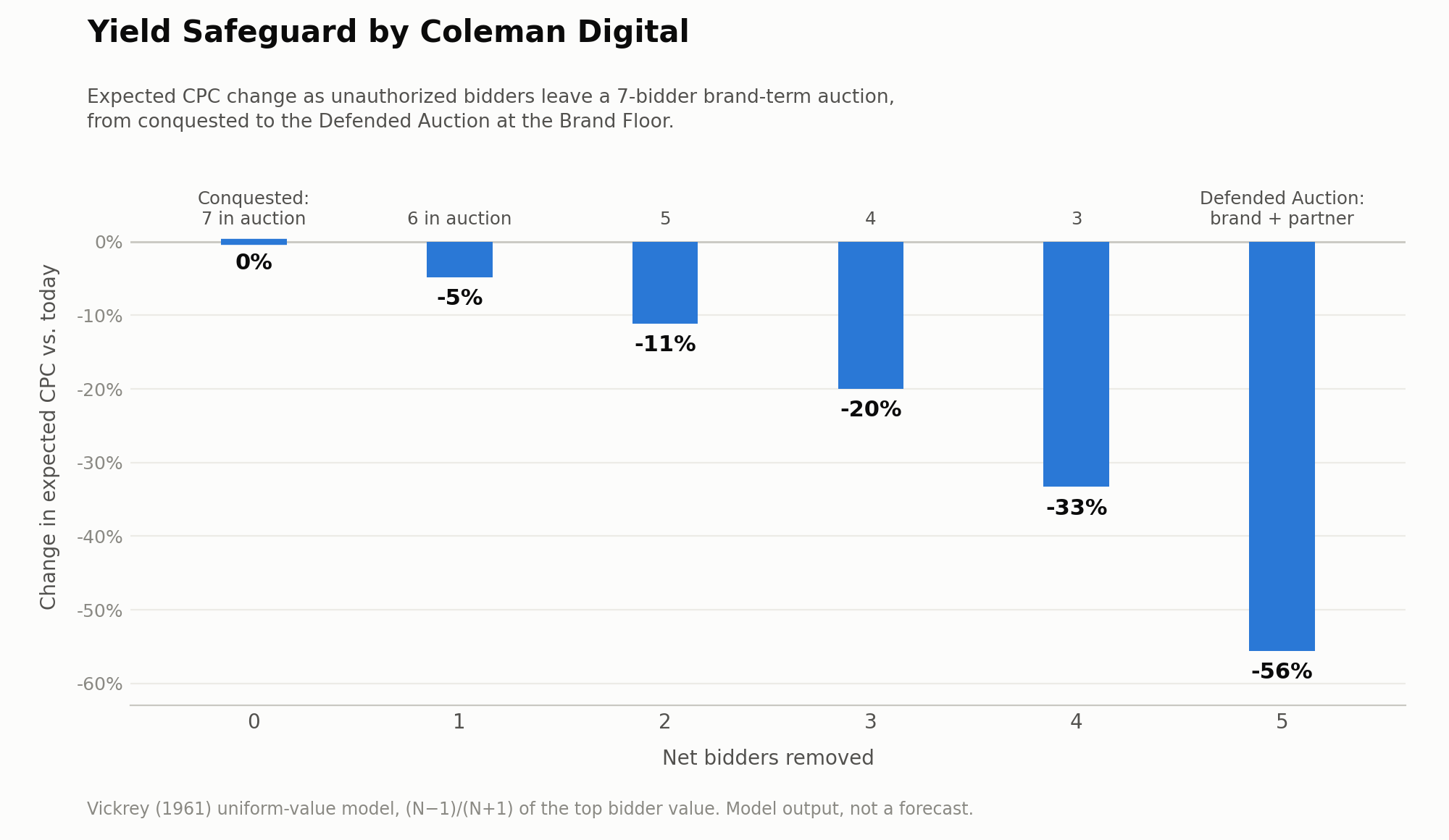
A typical crowded SERP for “[brand] promo code” shows 7 bidders: the advertiser plus 6 unauthorized entries. In the uniform model, removing all 6 and adding Yield Safeguard, the Defended Auction, takes the expected clearing price from 75% to 33% of the top bidder’s value, a 56% reduction.
The model curve (see the chart above) is convex: the last bidders removed are worth the most, which is why the goal is clearing the field rather than trimming it. The reduction assumption in the TM+ Savings Calculator is drawn from the range below rather than a single fixed percentage.
What reduction to assume. No published study measures the CPC change from removing affiliate bidders on a brand term, so the defensible approach is a range tied to the size of the field, bounded by two independent methods: the Vickrey model taken to a two-bidder end state, and Coey et al.’s 12–13% per-bidder effect compounded over the bidders removed (an extrapolation from timber auctions, shown here at 12.5%).
| Bidders today (brand + unauthorized) | Net removed | Vickrey model, full clearance | Coey et al. compounded |
|---|---|---|---|
| 3 | 1 | 33% | 13% |
| 4 | 2 | 44% | 23% |
| 5 | 3 | 50% | 33% |
| 6 | 4 | 53% | 41% |
| 7 | 5 | 56% | 49% |
| 8 | 6 | 57% | 55% |
For a field of five or more bidders the two methods agree on roughly 30–55%. Three cautions bound that from above: Google’s Ad Rank threshold, the Brand Floor, is a hard floor, so the realized reduction can never exceed the gap between today’s CPC and the threshold; partial clearance delivers far less than full clearance; and both methods assume symmetric bidders. The planning range is therefore 13% (one bidder removed, Coey et al.) to 57% (full clearance of an eight-bidder field, Vickrey model). For a single working figure, count the bidders on the brand’s own SERP and average the two methods in that row: a seven-bidder SERP gives 52%, a five-bidder SERP 42%. With no SERP in hand, the midpoint of the range, 35%, is the default; the geometric mean, 27%, is the conservative choice.
Limits and caveats
The evidence above supports the direction of the effect and its rough size. It does not support a precise forecast for any single keyword, for the reasons below.
- Google’s auction is not a textbook Vickrey auction. It is a quality-weighted, multi-position generalized second-price auction with undisclosed Ad Rank thresholds. Edelman et al. (2007) show truthful bidding is not even an equilibrium in GSP. The (N−1)/(N+1) numbers are a model illustration, not a prediction for any keyword.
- Only the bidder immediately below the advertiser sets its price, until the field is thinner than the slots. Removing bidders ranked further down does not move the advertiser’s CPC while a competitor still sits directly below it above the threshold. Once there are fewer bidders than positions, the bottom bidder pays only the threshold, and because each position’s price is the bid of the position below (Edelman et al.: “the second advertiser pays the bid of the third advertiser plus an increment; and so forth”), the whole price ladder collapses toward the floor. Edelman et al. add that “search engines charge the last advertiser a positive reserve price.” So the floor matters, and thinning the field below the slot count is what makes it bind. Google’s own wording (“the competitor immediately below you”) is the source.
- Bidders on a brand term are not symmetric. The trademark owner values a paid click only at its increment over the organic click it would get anyway (close to zero for eBay in Blake et al.), while an affiliate values it at its expected commission. Those are different quantities with no reason to be equal, and the model’s uniform, symmetric draws capture neither. Vickrey, Bulow–Klemperer and Coey et al. all assume symmetric bidders. Direction holds; magnitude does not transfer.
- Ad Rank thresholds are a floor, and the Defended Auction is two bidders. Zero competitors is the ideal (Blake et al.), but the field refills, so the state that can be held is the advertiser plus Yield Safeguard, each paying at least Google’s reserve.
- The 12–13% figure is from timber, not search. Coey et al. measured U.S. Forest Service ascending auctions. It is an order of magnitude from a peer-reviewed auction study, not a search-ads number.
- Simonov et al. is about competitors generally, not affiliates specifically. Their “competitors” on Bing include rivals, resellers and affiliates without distinction. It is the closest published analogue, not a study of affiliate bidding.
- Microsoft documents less than Google. Microsoft states only that “actual cost may be lower depending on competition.” This document applies the Google mechanism to Bing as a stated assumption.
- The field refills. Performance Max and AI Max for Search can enter an advertiser into brand-term auctions it never targeted unless that advertiser sets brand exclusions (Google Ads Help: brand settings; how AI Max for Search works). An auction cleared this month is not cleared next month without monitoring.
Sources
“Verified” means the quoted words or figures appear on the linked page as of 2026-09-23; “partial” means the page supports the direction but not the specific mechanism claimed.
| Source | Used for | Status |
|---|---|---|
| Google Ads Help — Actual cost-per-click | Pay-to-beat-the-next-ad rule; Ad Rank components | Verified |
| Google Ads Help — About the ad auction | Competition raises CPC; six auction factors | Verified |
| Google Ads Policy — Trademarks | Google does not restrict trademark keywords; complaints limited to ad text | Verified |
| Google Ads Help — Brand settings for Search and Performance Max | Brand settings “help your ads to appear with brands you are related to”; exclusions | Verified |
| Google Ads Help — How AI Max for Search works | Search term matching uses “broad match and keywordless technology” | Verified |
| Microsoft Advertising — Cost control | “Actual cost may be lower depending on competition” | Partial: no mechanism published |
| Microsoft Learn — Quality Score | Quality score not used at auction time | Verified |
| Microsoft Advertising — Performance Max | Optimizes “across multiple ad formats and placements” from goals and signals, not keywords | Verified |
| Vickrey 1961, J. Finance 16(1) | Second-price mechanism; (N−1)/(N+1) formula, p. 25 | Verified; formula also checked by simulation |
| Bulow & Klemperer 1996, AER 86(1) | N+1 bidders beat any negotiation with N | Verified |
| Edelman, Ostrovsky & Schwarz 2007, AER 97(1) | GSP mechanism; not a Vickrey auction; reserve-price footnote | Verified |
| Simonov, Nosko & Rao 2018, Marketing Science 37(2) | Competitors steal 1–5% (brand present), 18–42% (absent); defensive ROI strongly positive | Verified (abstract quoted) |
| Coey, Larsen & Sweeney 2019, RAND J. Econ. 50(1) | Bidder exclusion effect ~12–13% in timber auctions | Verified |
| Blake, Nosko & Tadelis 2015, Econometrica 83(1) | 99.5% of brand-keyword clicks recaptured organically; no measurable benefit | Verified (author manuscript) |
| 1-800 Contacts v. FTC, 2d Cir. 2021 (Justia) and WSGR summary | FTC theory: agreements not to bid on rivals’ trademarks reduced ad prices; reversed on legal standard | Verified |
| Google v. American Blind & Wallpaper Factory (Wikipedia summary; N.D. Cal. No. 5:03-cv-05340) | Settled 2007 with keyword policy unchanged | Partial: settlement terms from a secondary summary |
| Rosetta Stone v. Google settlement (Justia, 2012-11-05) | 4th Cir. 2012 reversal; November 2012 settlement, terms undisclosed | Verified |
| CJEU C-236/08 Google France v. Louis Vuitton, operative part | Keyword storage “does not use that sign” | Verified |
| Stanford CIS on Google’s September 2010 European policy change | Keywords “will not be restricted”; “limited investigation” of ad text only | Partial: contemporaneous secondary report |
| TNW on the April 23, 2013 worldwide change | Worldwide lifting of keyword restrictions; consumer-choice quote | Partial: contemporaneous secondary report |